
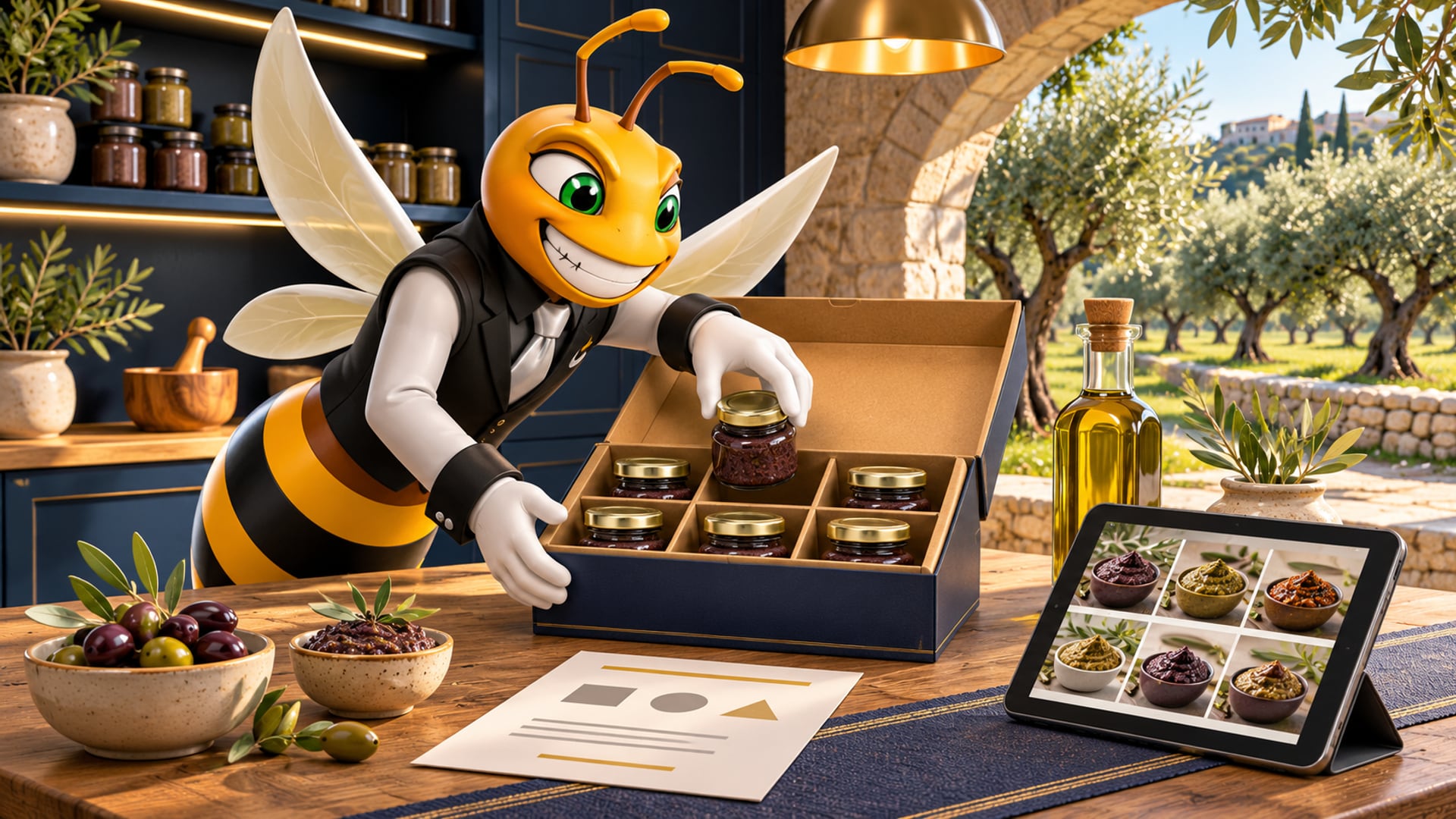

A professional buyer sees your olive paste at a trade show or in an online catalogue. The presentation appeals to them, and they want to assess whether it fits their distribution network. Your website offers attractive photographs and a family story, but it is difficult to identify the packaging shown or request a sample. There is interest, yet the next commercial step remains unclear.
For a business considering Greek food exports to Germany, the website needs to support that transition. Greece’s presence at ANUGA 2025 in Cologne, including national participation organised by Enterprise Greece, provides a real example of reaching international trade buyers. Entering that environment creates contacts to assess. The website needs to help those buyers take the next step after that first contact.
Help the Buyer Decide Whether a Sample Is Worth Requesting
Start with the particular role you want to reach. An importer, a delicatessen network and a food-service buyer may all be interested in the same product while assessing different packaging, uses and commercial arrangements. A general invitation to contact you postpones every distinction until the first email.
The catalogue should support an initial assessment of fit. Visitors need to identify the product, the pack they are considering and how your business handles trade supply. Your brand story provides context. Specific information lets the buyer continue their work and explain the choice to colleagues involved in the decision.
Give Product Information an Owner and a Version
For each selected product, organise the information you can substantiate: description, reference, net quantity, case configuration, storage conditions and available technical documentation. If you display a certification or special characteristic, establish exactly which product it covers and whether it remains valid. Buyers should not have to assume that a badge shown on one page covers the entire catalogue.
Ingredients and allergen information require particular care. The EU food-information framework includes relevant obligations, while the applicable details depend on the product and how it is supplied. Whoever maintains the website should use approved, current business information and coordinate it with the person responsible for labelling. Well-written sales copy does not amount to a compliance assessment.
There is also a practical issue: when packaging or an approved specification changes, who updates the page and the downloadable file? A version date and a clear owner help distinguish an old presentation from the current product. A small catalogue may need only a simple, controlled update process.
Turn a Catalogue Item into a Request Your Team Can Handle
Consider a hypothetical example. A Greek producer lists olive paste in a 180-gram jar, packed in cases of twelve. A distributor in Germany wants six samples for its commercial team to assess. These are assumptions for this example, not recommended quantities or rules for every exporter.
A Request a Sample action can carry the product reference and selected pack into the enquiry. The buyer adds the company, their professional role, the channel they serve and the purpose of the assessment. The form asks for what the responsible person needs to review the request, while delivery details are confirmed at the appropriate stage.
The acknowledgement should describe what actually happened: the request was recorded and will be reviewed. Before approving dispatch, your team checks sample availability, destination, transport conditions and any cost or commercial boundary that needs agreement. Clicking a button should not create a promise that production or the export team has not accepted.
Dispatch Is Not Yet a Commercial Outcome
After acceptance, someone should know which product version was sent, to whom and for what purpose. A concise history helps the next message address that particular assessment. It may call for a question about packaging suitability or an invitation to discuss supply terms, depending on the original agreement.
Useful stages include a request under review, an approved sample dispatch, a delivered sample and the next agreed commercial action. Not every small business needs a complex CRM. It does need to distinguish these events, so a catalogue download or a parcel leaving the premises is not recorded as a completed sale.
Carry the Language Choice Through to the Response
Your choice of German or English should follow the audience you have selected and your team’s ability to serve it. Product terminology should agree across the page, specification, form and response. A clear German page loses its usefulness if the acknowledgement changes product references or the responsible person cannot continue the conversation.
Before launch, ask someone familiar with the relevant trade terminology to follow the whole journey. Have them find a particular pack, identify the current specification and explain what happens after submission. The test examines whether they can complete their task. Correcting individual words alone will not establish that.
Start with One Journey Your Team Can Support
Begin with a few products and one clearly defined buyer type. Submit a complete test request and an incomplete one, check who receives them, and see what happens if the selected pack has changed. Keep test submissions separate from genuine enquiries. This checks the operation without manufacturing an appearance of commercial success.
Related Stigmahost services
Stigmahost Web Design can support the structure of this journey, while Web Development covers the functions connecting catalogue, submission and management. A useful first brief includes one product’s approved specification, the buyer you want to serve and the next step your team can actually take responsibility for.