
Recommended Services
Supported Scripts
Web Development · Dublin
Development for customer portals.
Define a complete feature.
Replace disconnected tasks with a web system your team can follow. We map the process, agree the scope and deliver in reviewable stages.


Designed for your project
A portal should expose the information and actions each customer or staff role needs. Define permissions at the data level as well as in the interface. Define a complete technical feature and its acceptance behaviour before expanding the build.

Fast and scalable
The initial design includes room for agreed future requirements without pretending every possible feature belongs in version one.

Security from the start
We document who can view, create and change information before connecting the interface to live data.
The tools follow
the task.
We consider existing infrastructure and long-term support alongside the immediate development requirements.
- Mobile-first web applications and responsive interfaces
- Custom dashboards, portals and internal tools
- API integrations with existing systems
- AI-assisted features where they add real value
- Cloud-connected and database-driven solutions
Development in stages
you can review.
You can review progress at agreed points and assess what has been completed before the next stage begins.
- Discovery—we document needs, users, workflows and constraints.
- UX/UI design—we design clear screens and practical user journeys.
- Development—we build in controlled stages and keep you updated.
- Testing—we check features, forms, performance and essential security measures.
- Deployment—we plan the release and carry out final checks.
- Support and upgrades—we agree on maintenance and future improvements.


Custom development,
with clear boundaries.
We look at the users, data and systems surrounding the task. That provides a practical specification for what needs to be built and what can remain unchanged.

Mobile Apps

Web Applications

eCommerce

Dashboards & SaaS

Integrations with a purpose.
We examine the available APIs and the way your team uses the data before proposing an integration.
- CRMs, ERPs and payment gateways
- E-commerce, social and community tools
- IoT, forms and external data sources where needed
- Chatbots and AI assistants with clear boundaries
- Custom backend systems and APIs
Connections depend on access permissions, available API functions and the terms of the external platform. We check these constraints at the start.
A PRACTICAL STARTING POINT
Replace a manual workaround with a maintainable workflow.
Map the existing steps and their exceptions before building a replacement. The first release should solve a defined task and leave a clear operating handover.
01 · Prepare
Identify what already works, where people get stuck and which URLs or records must survive the change.
02 · Verify
Compare the old and new journey using the same tasks. Check retained information and the transition path.
03 · Keep ownership clear
Keep a record of changed behaviour, the people affected and the process for subsequent corrections.
Illustrative sequence. The actual configuration and responsibilities follow the agreed requirements.
DELIVERY & OWNERSHIP
Confirm the dependency before building around it.
Identify the provider, available access and the functions the external service actually supports. Include licence or usage restrictions that could affect the proposed work.
01 · Prepare
Validate API access, field mappings and provider restrictions before implementation.
02 · Verify
Verify field mapping, authentication, rejected inputs and repeated requests against the actual provider API.
03 · Keep ownership clear
Document credential ownership, retry limits and the route for external-integration failures.
OUR WORK
Development that connects the working parts.
Examples of websites, tools and connected systems.

PlegmaHost
A corporate website connected to WHMCS
We developed a WordPress website linked to WHMCS, organising package information, registration and service management into one customer journey.
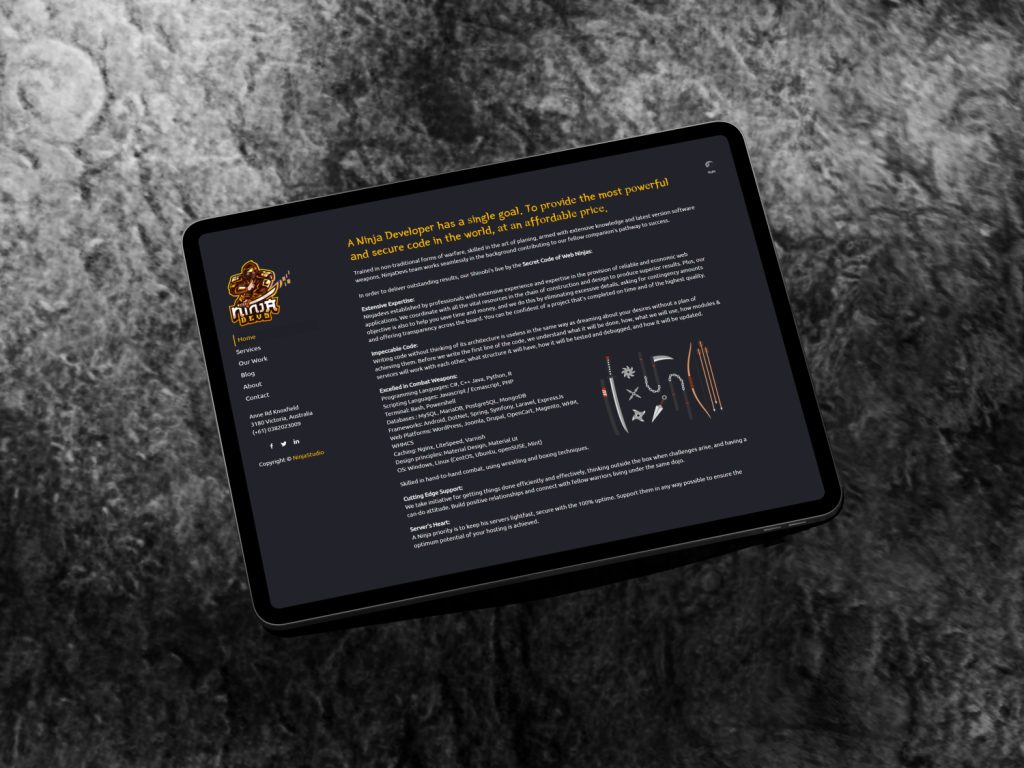
NinjaStudio / Ninja Devs
Presenting development services
We created a business website connecting a creative studio’s identity with its technical work, using a clear service structure and a distinctive visual language.
IN OUR CLIENTS’ WORDS
“His pricing is excellent, and his hosting options are more than fair. Communication was outstanding every time I contacted him, he responded promptly. When I had an issue with my email ,which was something I did to mess it up , he jumped straight on it and had everything sorted quickly.”
Benjamin S.
SERVICE AREA
For your audience in Dublin.
Member journeys.
A team serving Dublin may collaborate from more than one place. Agree who supplies information and who approves changes without assuming everyone shares an office or schedule.
Identify application roles and the people authorised to approve deployments.
The map identifies the audience area. Project scope, collaboration and delivery are agreed around the business and its users; it does not imply a local office.
- Source of truth
- Update direction
- Retries and duplicate prevention
Dublin
What should your next tool do?
Share the existing systems and the outcome you need. We will help define a build that can be reviewed and maintained.

A modern stack for web applications and workflows.

HTML5

CSS3

JavaScript

Angular

ReactJS

Node.js

CloudLinux
PRACTICAL QUESTIONS
Before we agree the next step.
Questions about the work, the checks and the handover.
Where it affects replies or processing, it can be useful to record it explicitly. Define how the receiving system uses that value and what happens if it is missing.
Often the useful change is a bounded feature or integration. Review existing capabilities and maintenance constraints before committing to a wider replacement.
The integration needs an agreed failure response: a visible error, queued retry or manual review, depending on the operation. Define limits and duplicate handling before adding automatic retries.
YOUR NEXT STEP
Build the rules behind the booking journey.
Show us the current service and what must continue working. We can discuss a controlled transition rather than an isolated replacement.
Preserve existing records and working integrations during a platform change.