
Recommended Services
Supported Scripts
Web Development · Utrecht
Development for system integrations.
Understand the API limits.
Bring us the technical gap, not a predetermined stack. We review the constraints and identify a maintainable way to deliver the required functionality.


Designed for your project
APIs need rules for permissions, field mapping, retries and duplicate records. Start with a bounded exchange of information that can be verified. Validate API access, field mappings and provider restrictions before implementation.

Fast and scalable
We account for foreseeable changes in users, data and features when defining the architecture.

Security from the start
User access, authentication and permissions are defined alongside the functionality.
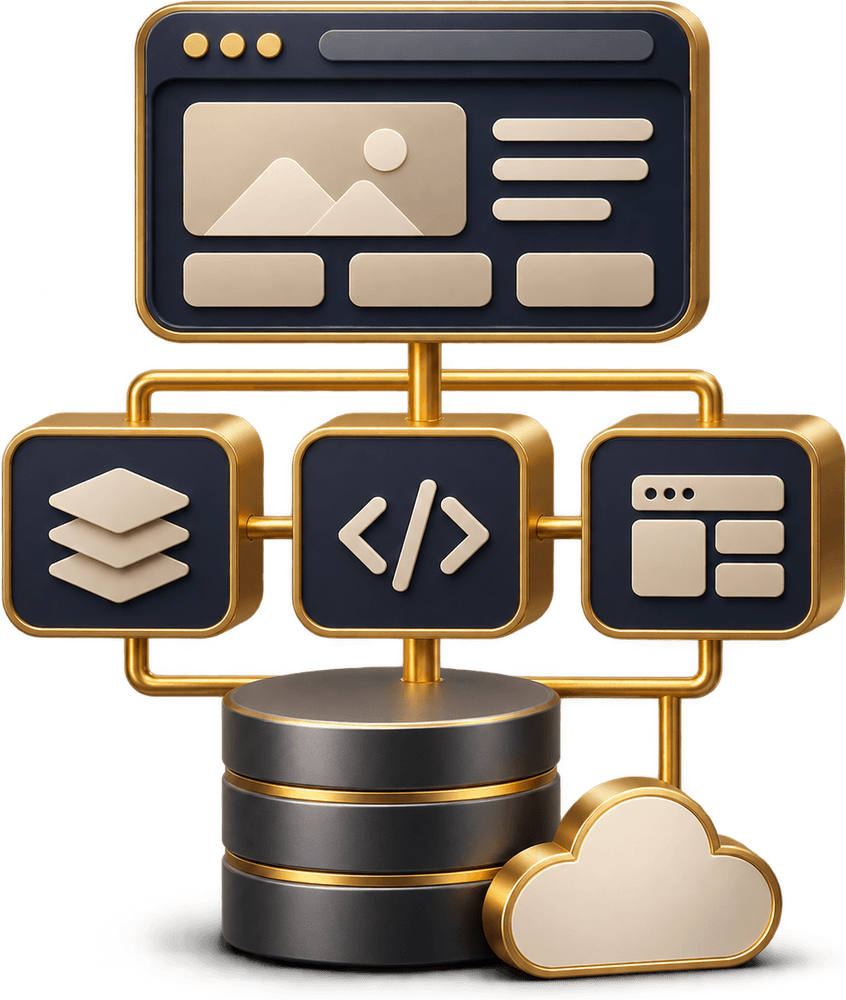
A maintainable build starts
with a clear technical brief.
The platform is selected against the features, integration options, budget and people who will maintain it.
- Mobile-first web applications and responsive interfaces
- Custom dashboards, portals and internal tools
- API integrations with existing systems
- AI-assisted features where they add real value
- Cloud-connected and database-driven solutions
From specification
to a tested release.
You can review progress at agreed points and assess what has been completed before the next stage begins.
- Discovery—we document needs, users, workflows and constraints.
- UX/UI design—we design clear screens and practical user journeys.
- Development—we build in controlled stages and keep you updated.
- Testing—we check features, forms, performance and essential security measures.
- Deployment—we plan the release and carry out final checks.
- Support and upgrades—we agree on maintenance and future improvements.


Custom development,
with clear boundaries.
A customer portal, reporting tool or booking workflow needs a clear role. We define that role before adding screens and features.

Mobile Apps

Web Applications

eCommerce

Dashboards & SaaS

Make your systems
work together.
We examine the available APIs and the way your team uses the data before proposing an integration.
- CRMs, ERPs and payment gateways
- E-commerce, social and community tools
- IoT, forms and external data sources where needed
- Chatbots and AI assistants with clear boundaries
- Custom backend systems and APIs
We establish the source of each record, the update direction and error handling before connecting services.
A PRACTICAL STARTING POINT
Connect the catalogue to the way orders are handled.
Product data, pricing rules and order handovers must agree across the website and connected systems. Define ownership and update rules before building the integration.
01 · Prepare
Prepare representative products, categories, images and the information customers need before making a decision.
02 · Verify
Review a product on mobile and desktop, including variations, specifications and the next step to enquire or purchase.
03 · Keep ownership clear
Keep an owner for product information, stock-related connections and future catalogue changes.
Illustrative sequence. The actual configuration and responsibilities follow the agreed requirements.
DELIVERY & OWNERSHIP
Make the handovers understandable to the whole team.
List the people who provide information, approve changes and use the result. Separate everyday access from the ability to change important settings or publish material.
01 · Prepare
Identify application roles and the people authorised to approve deployments.
02 · Verify
Test server-side permissions for each intended role, including actions reached without the normal interface.
03 · Keep ownership clear
Keep access ownership, deployment approval and the person responsible for application changes explicit.
OUR WORK
Development that connects the working parts.
Examples of websites, tools and connected systems.

Biohistory
Research made accessible online
We structured scientific content into a readable digital experience, combining multimedia and mobile layouts without losing the substance of the research.

Web Design Forum
A community for knowledge and experience
We built a community environment with news, guides, project collections and member interaction for designers and developers.
IN OUR CLIENTS’ WORDS
“His pricing is excellent, and his hosting options are more than fair. Communication was outstanding every time I contacted him, he responded promptly. When I had an issue with my email ,which was something I did to mess it up , he jumped straight on it and had everything sorted quickly.”
Benjamin S.
SERVICE AREA
For your audience in Utrecht.
More than one language.
Web functionality for your team in Utrecht. List the external services the work depends on. Confirm the necessary access and each provider’s responsibilities.
Validate API access, field mappings and provider restrictions before implementation.
The map shows the area your project serves.
- User roles
- Record ownership
- Validation and exception handling
Utrecht
What should your next tool do?
Describe the process, who uses it and where the current setup fails. We will discuss requirements and feasible next steps.

A modern stack for web applications and workflows.

HTML5

CSS3

JavaScript

Angular

ReactJS

Node.js

CloudLinux
PRACTICAL QUESTIONS
Before we agree the next step.
Questions about the work, the checks and the handover.
Choose the authoritative source for each field and describe how changes propagate. Price, stock and descriptive content do not necessarily have to share the same owner.
No. The server must enforce permissions for the underlying action and record. Interface visibility helps usability but cannot substitute for authorisation.
Where it affects replies or processing, it can be useful to record it explicitly. Define how the receiving system uses that value and what happens if it is missing.
YOUR NEXT STEP
Replace a manual workaround with a maintainable workflow.
Tell us how you expect the service to evolve and who will look after it. We can agree a handover that supports the next change.
Keep deployment, dependency updates and integration ownership documented.